"Now that English sparrows have a price set upon their heads*, what is to prevent some industrious, able-bodied fellow from raising them for the bounty?"
"The Washtenaw agricultural association will hold a cattle fair on the fair ground at Ann Arbor this spring. Sheep shearing prizes will be offered."
"At Fred Davis' drug store may be seen an orange brought home by Capt. Wallace from California, which is over thirteen inches in circumference and weighs nearly fifteen ounces."
"The Young People's Society of the M. E. church will give a maple sugar social in the chapel of the church next Tuesday evening. Hot biscuit and sugar will be served."
"Take Advantage of it While You Can. The Michigan Central Railroad, in appreciation of the liberal patronage to their cheap excursion given last summer now invites you all to go and see the greatest painting ever produced, and known as the 'Battle of Atlanta,' now on exhibition at Detroit, and will make the fare for the trip almost equal to a free excursion. A special train of ten coaches will leave Ypsilanti at 8:50 a.m.; returning will leave Detroit at 5 p.m. Room for all guaranteed. Rates for the round trip, 80 cents for adults; children 12 years of age, 40 cents. Grasp your opportunity and remember the date, Saturday, March 19."**
*For a time a bounty was placed on English sparrows, calculated by the numbers of severed you brought in to some lucky clerk in City Hall. The non-native birds were viewed as pests to farmers.
**Yes, people took a train trip to see a single painting--but this was no ordinary painting. William Wehner's enormous 1886 work 'The Cyclorama of the Battle of Atlanta' covers over 15,000 square feet and weighs over 10,000 pounds. It is the largest oil painting in the world and still exists, on display in Atlanta.
Showing posts with label commercial. Show all posts
Showing posts with label commercial. Show all posts
Saturday, March 17, 2012


Saturday, March 10, 2012
Gyrating Bicycle; Circuses; Arrested for Truancy: Tidbits from the March 11, 1887 Ypsilanti Commercial
"Jane Simmons was taken to Adrian* Tuesday for one year. She was arrested under the truancy law and sentenced by Justice Joslyn.
"The Queen City** Quartet will furnish music for the prohibitory amendment meetings which will be held."
"The small boy should be happy, and economical. Three large circuses, Forepaugh's, Dorris', and Sells Brothers', will invade Michigan early this spring."
"The W. C. T. U. will meet at the Methodist chapel Tuesday afternoon, March 15, at 3 o'clock. Topic, Will the prohibitory amendment, if carried, interfere with the use of fermented wine for sacramental purposes? The question for discussion last week, That the tax or license system interferes with the liberty of a greater number of persons than a prohibitory law, was nearly unanimously decided in the affirmative."
"The warm weather has brought out the bicycle, and during the past week Charlie Sweet has been putting his through an unusual number of gyrations much to the enjoyment of the spectators. Charlie has become an adept with the 'wheel'."
--Ypsilanti Commercial, March 11, 1887
*Adrian had a state institution designed for errant girls. Supposedly one main building on the grounds had basement jail cells where especially troublesome girls were kept.
**Ypsilanti was one of several Michigan cities that gave itself the nickname "Queen City."
"The Queen City** Quartet will furnish music for the prohibitory amendment meetings which will be held."
"The small boy should be happy, and economical. Three large circuses, Forepaugh's, Dorris', and Sells Brothers', will invade Michigan early this spring."
"The W. C. T. U. will meet at the Methodist chapel Tuesday afternoon, March 15, at 3 o'clock. Topic, Will the prohibitory amendment, if carried, interfere with the use of fermented wine for sacramental purposes? The question for discussion last week, That the tax or license system interferes with the liberty of a greater number of persons than a prohibitory law, was nearly unanimously decided in the affirmative."
"The warm weather has brought out the bicycle, and during the past week Charlie Sweet has been putting his through an unusual number of gyrations much to the enjoyment of the spectators. Charlie has become an adept with the 'wheel'."
--Ypsilanti Commercial, March 11, 1887
*Adrian had a state institution designed for errant girls. Supposedly one main building on the grounds had basement jail cells where especially troublesome girls were kept.
**Ypsilanti was one of several Michigan cities that gave itself the nickname "Queen City."
Saturday, March 3, 2012
Prohibition Frenzy; Strange-Looking Elocutionist; Water Works Uncertainty: Tidbits from the March 4, 1887 Ypsilanti Commercial
"The crowd that customarily greets the numbers of the Normal Lecture Course was on hand last Monday evening to listen to Mrs. Laura Dainty's readings. Her appearance did not predispose the audience in her favor, but before her first selection was finished she had their sympathy, and held it till the close of the entertainment. She has a good voice, well trained, and is perfectly at home before an audience, but her work as a whole does not compare favorably with Mr. Burbank's."
"The dry goods stock of the late Joseph Kitchen was sold at auction by C. L. Yost this week. Mrs. H. D. Martin will move into the Kitchen store Mar. 15."*
"It must be evident to all candid minds that our people are not prepared to vote on the water works question, until they had more definite information as to a source of supply and the probable cost. What then justified the action of the Council in refusing to hire an expert to investigate the matter?"
"Opera House for March:
Manager Curtis announces that the dates for March at the Opera House have been filled as follows:
Mar 10: Wrestling match between Jake Martin of Ypsilanti and T. J. Murphy of Minneapolis.
Mar. 11: Walter Thomas Mills on the prohibition amendment under auspices of W. C. T. U.**
Mar. 15: M. E. Hawks, lecture on the prohibition amendment under auspices of W. C. T. U.
Mar. 17: St. Patrick's Day--the great play 'Devil's Auction or the Golden Branch,' under the personal management of Chas. H. Yale.
Mar. 20: Col. Geo. W. Bain, of Ky., lecture under the auspices of the W. C. T. U. on the prohibition amendment.
Mar. 21: Mendelshon [sic] Quintet Club of Boston, the last in the series of Normal Lecture and Music Course entertainments.
Mar. 23: Sylvester Larned on the prohibition amendment under the auspices of the city committee.
Mar. 24: Young Men's Prohibitory Amendment Club mass meeting--the addresses to be by young men.
Mar. 26: Afternoon and evening, Prof. Morris' celebrated trained dogs.
Mar. 31: Hon. John B. Finch under the auspices of the W. C. T. U., a lecture on [take a wild guess --ed.] the prohibition amendment.
--Ypsilanti Commercial, March 4, 1887
*She opened a millinery store.
**Women's Christian Temperance Union.
"The dry goods stock of the late Joseph Kitchen was sold at auction by C. L. Yost this week. Mrs. H. D. Martin will move into the Kitchen store Mar. 15."*
"It must be evident to all candid minds that our people are not prepared to vote on the water works question, until they had more definite information as to a source of supply and the probable cost. What then justified the action of the Council in refusing to hire an expert to investigate the matter?"
"Opera House for March:
Manager Curtis announces that the dates for March at the Opera House have been filled as follows:
Mar 10: Wrestling match between Jake Martin of Ypsilanti and T. J. Murphy of Minneapolis.
Mar. 11: Walter Thomas Mills on the prohibition amendment under auspices of W. C. T. U.**
Mar. 15: M. E. Hawks, lecture on the prohibition amendment under auspices of W. C. T. U.
Mar. 17: St. Patrick's Day--the great play 'Devil's Auction or the Golden Branch,' under the personal management of Chas. H. Yale.
Mar. 20: Col. Geo. W. Bain, of Ky., lecture under the auspices of the W. C. T. U. on the prohibition amendment.
Mar. 21: Mendelshon [sic] Quintet Club of Boston, the last in the series of Normal Lecture and Music Course entertainments.
Mar. 23: Sylvester Larned on the prohibition amendment under the auspices of the city committee.
Mar. 24: Young Men's Prohibitory Amendment Club mass meeting--the addresses to be by young men.
Mar. 26: Afternoon and evening, Prof. Morris' celebrated trained dogs.
Mar. 31: Hon. John B. Finch under the auspices of the W. C. T. U., a lecture on [take a wild guess --ed.] the prohibition amendment.
--Ypsilanti Commercial, March 4, 1887
*She opened a millinery store.
**Women's Christian Temperance Union.
Saturday, February 25, 2012
Adulterers Jailed; Patient Abuse; Infusorial Earth: Tidbits from the February 25, 1887 Ypsilanti Commercial
"Monthly meeting of Washtenaw Pomological society on the 5th of March, at 2 o'clock p.m. in the basement of the Court House at Ann Arbor. Report of committees on fruit factory, on infusorial* earth, on best and cheapest fruit packages, on statistics. Prof. J. B. Steere will lead in the discussion on noxious insects and insecticides."
"The Knights of Honor* up to this time have paid Mrs. James E. Lawrence $2,000, Mr. Lawrence being a member of the order when he died."
"John Girdler and Carrie Gill of Grand Rapids have been convicted of adultery. Girdler pleads hard to be allowed to suffer the full penalty alone, but the judge thought both should be punished, and sentenced Girdler to the state prison for one year, and Carrie Gill to the Detroit house of corrections for the same time."
"TORTURING PATIENTS. Extreme Cruelty Charged at the Soldiers' Home at Grand Rapids, Mich. LANSING, Mich.,--Some of the testimony given at the examination of the inmates of the Soldiers' home in Grand Rapids has been made public. The most damaging stories were related by Private Keyes and Baker. They swore that the principal nurse of the hospital--Sergt. Downs--so maltreated one of the inmates named Moore that he died the next morning. When the dying man objected to taking medicine, Downs said: "Take it, you d----- d----- ----- ----- -----, or I will throw you out of the window." The testimony shows that Downs jumped on Moore with his knees and forced obedience to his demands. Other specified instances of extreme cruelty are sworn to. One veteran swears that cayenne pepper was put in liniment in order to cause excruciating pain. Sick men were given icy baths. The testimony abounds in incidents in which the officials used profane and obscene language. Several of the subordinate officers admit to the profanity and try to justify it. The legislative committee says that these circumstances were unknown to the management."
--Ypsilanti Commercial, February 25 1887
*one of the innumerable fraternal orders of the era.
*diatomaceous, possibly used (as it still is) to deter insects by sprinkling on the ground around plants.
"The Knights of Honor* up to this time have paid Mrs. James E. Lawrence $2,000, Mr. Lawrence being a member of the order when he died."
"John Girdler and Carrie Gill of Grand Rapids have been convicted of adultery. Girdler pleads hard to be allowed to suffer the full penalty alone, but the judge thought both should be punished, and sentenced Girdler to the state prison for one year, and Carrie Gill to the Detroit house of corrections for the same time."
"TORTURING PATIENTS. Extreme Cruelty Charged at the Soldiers' Home at Grand Rapids, Mich. LANSING, Mich.,--Some of the testimony given at the examination of the inmates of the Soldiers' home in Grand Rapids has been made public. The most damaging stories were related by Private Keyes and Baker. They swore that the principal nurse of the hospital--Sergt. Downs--so maltreated one of the inmates named Moore that he died the next morning. When the dying man objected to taking medicine, Downs said: "Take it, you d----- d----- ----- ----- -----, or I will throw you out of the window." The testimony shows that Downs jumped on Moore with his knees and forced obedience to his demands. Other specified instances of extreme cruelty are sworn to. One veteran swears that cayenne pepper was put in liniment in order to cause excruciating pain. Sick men were given icy baths. The testimony abounds in incidents in which the officials used profane and obscene language. Several of the subordinate officers admit to the profanity and try to justify it. The legislative committee says that these circumstances were unknown to the management."
--Ypsilanti Commercial, February 25 1887
*one of the innumerable fraternal orders of the era.
*diatomaceous, possibly used (as it still is) to deter insects by sprinkling on the ground around plants.
Saturday, February 18, 2012
Poop Vaults; Donkey Social; Lettuce Sample: Tidbits from the February 18, 1887 Ypsilanti Commercial
"There is a rumor abroad that Mr. F. J. Swaine* has refused to purchase barley from farmers in this locality on account of the submission of the prohibition amendment.** Mr. Swaine says there is no truth in the statement."
"MEMBERS OF THE BOARD OF EDUCATION.--Messrs." Why don't you clean out that sink of corruption, the privy vaults at the Seminary? Why don't you replace them by boxes, easily removed and cleaned at least monthly? We call the attention to the Board of Health to this matter."
"Wednesday evening of this week a donkey social was given at the residence of D. L. Quirk, under the auspices of the Ladies' Aid Society of St. Luke's, which about 225 of our people attended. A number were present from Detroit and Ann Arbor. A very pleasant social and dancer were enjoyed. A prize was given the one putting the donkey's tail nearest the right place, a vase, which was won by Mrs. Dr. Watling; also one to the person getting it farthest away. The second prize, a miniature donkey, was won by Miss Maggie VanCleve, who received it with her customary grace of witty repartee. Miss VanCleve honored Chas. R. Whitman by pinning her prize on his coat. The "donkey" to this day remaineth at the house of one D. L. Quirk of Ypsilanti, and awaiteth the coming of the true owner thereof, when it shall be given unto her."
"Mr. Cassler has winter lettuce, over the river, a number of beds, growing out doors in hot beds, very nice and tender. He left a specimen with us."
--February 18, 1887 Ypsilanti Commercial
* Frederick Swaine of Forest Street was a maltster. Per Janice Anschuetz, who currently occupies the Swaine home, "On stationary and business cards, Frederick Swaine presented himself as “Maltster and Dealer in Barley, Malt and Hops.”
**an amendment to MI's constitution adopted Nov. 1, 1916; MI ratified the federal 18th Amendment on January 2, 1919.
"MEMBERS OF THE BOARD OF EDUCATION.--Messrs." Why don't you clean out that sink of corruption, the privy vaults at the Seminary? Why don't you replace them by boxes, easily removed and cleaned at least monthly? We call the attention to the Board of Health to this matter."
"Wednesday evening of this week a donkey social was given at the residence of D. L. Quirk, under the auspices of the Ladies' Aid Society of St. Luke's, which about 225 of our people attended. A number were present from Detroit and Ann Arbor. A very pleasant social and dancer were enjoyed. A prize was given the one putting the donkey's tail nearest the right place, a vase, which was won by Mrs. Dr. Watling; also one to the person getting it farthest away. The second prize, a miniature donkey, was won by Miss Maggie VanCleve, who received it with her customary grace of witty repartee. Miss VanCleve honored Chas. R. Whitman by pinning her prize on his coat. The "donkey" to this day remaineth at the house of one D. L. Quirk of Ypsilanti, and awaiteth the coming of the true owner thereof, when it shall be given unto her."
"Mr. Cassler has winter lettuce, over the river, a number of beds, growing out doors in hot beds, very nice and tender. He left a specimen with us."
--February 18, 1887 Ypsilanti Commercial
* Frederick Swaine of Forest Street was a maltster. Per Janice Anschuetz, who currently occupies the Swaine home, "On stationary and business cards, Frederick Swaine presented himself as “Maltster and Dealer in Barley, Malt and Hops.”
**an amendment to MI's constitution adopted Nov. 1, 1916; MI ratified the federal 18th Amendment on January 2, 1919.
Saturday, February 11, 2012
Corpse in a Horse; Streetcar Skirts; Gone Where the Woodbine Twineth: Tidbits from the February 11, 1887 Ypsilanti Commercial
"The Milan Journal has gone where the woodbine twineth.* Mr. Smith, of the Leader, has bought it. It is as much as one paper can do to live there, saying nothing about two."
"When a woman gets on a street-car and spreads out her skirts so that she occupies two seats, you can make up your mind that her husband sits on the edge of his chair and says 'Yes m'm,' 'No, m'm," to her. --New Haven News"
"CONCEALED IN A CARCASS: The Body of a Man Found in the Carcass of a Dead Horse. LOUISVILLE, Ky.,--A most horrible discovery was made in Green county, this state, last Saturday. The dead body of John Keeth was found wrapped in a blanket and concealed inside the carcass of a dead horse. It is supposed that he was murdered and his body concealed there by the murderer. Keeth was a brother-in-law of William Despain. He had been missing for several days, but no search had been made for him, his friends supposing that he was away on a visit, until a dog belonging to William Despain came into the house on Saturday morning, carrying something in his mouth which, when examined, was found to be the hand of a man. Mr. Despain tracked the dog to the carcass of an old horse, and was horrified to find the body of his brother-in-law therein, half eaten up by dogs. It was a horrible sight. The mystery connected with the affair will probably never be solved. Keeth was a married man and the father of six children."
"The Seniors, Juniors, and teachers of the High School were invited to a candy pull, Thursday evening, at the residence of Mr. H. F. Miller. It was given by Misses Dora Ambrose and Blanche Mott. They all had a very enjoyable time."
"The privy vaults must go. Citizens of Ypsilanti, shall these putrid pits of disease and death remain? Why not before spring comes have them substituted by dry privies, boxes? Why not have a city scavenger employed to see that all excretions from these, and all the offal in barn yards be removed monthly?"
"The Commercial tenders its thanks to D. W. Shipman for a bunch of celery which is certainly of a high order allowing us to be judge."
--Ypsilanti Commercial, February 11, 1887
*From the Facts on File Dictionary of American Regionalisms by Robert Hendrickson:

"When a woman gets on a street-car and spreads out her skirts so that she occupies two seats, you can make up your mind that her husband sits on the edge of his chair and says 'Yes m'm,' 'No, m'm," to her. --New Haven News"
"CONCEALED IN A CARCASS: The Body of a Man Found in the Carcass of a Dead Horse. LOUISVILLE, Ky.,--A most horrible discovery was made in Green county, this state, last Saturday. The dead body of John Keeth was found wrapped in a blanket and concealed inside the carcass of a dead horse. It is supposed that he was murdered and his body concealed there by the murderer. Keeth was a brother-in-law of William Despain. He had been missing for several days, but no search had been made for him, his friends supposing that he was away on a visit, until a dog belonging to William Despain came into the house on Saturday morning, carrying something in his mouth which, when examined, was found to be the hand of a man. Mr. Despain tracked the dog to the carcass of an old horse, and was horrified to find the body of his brother-in-law therein, half eaten up by dogs. It was a horrible sight. The mystery connected with the affair will probably never be solved. Keeth was a married man and the father of six children."
"The Seniors, Juniors, and teachers of the High School were invited to a candy pull, Thursday evening, at the residence of Mr. H. F. Miller. It was given by Misses Dora Ambrose and Blanche Mott. They all had a very enjoyable time."
"The privy vaults must go. Citizens of Ypsilanti, shall these putrid pits of disease and death remain? Why not before spring comes have them substituted by dry privies, boxes? Why not have a city scavenger employed to see that all excretions from these, and all the offal in barn yards be removed monthly?"
"The Commercial tenders its thanks to D. W. Shipman for a bunch of celery which is certainly of a high order allowing us to be judge."
--Ypsilanti Commercial, February 11, 1887
*From the Facts on File Dictionary of American Regionalisms by Robert Hendrickson:

Wednesday, October 12, 2011
Tidbits from the October 12, 1878 Ypsilanti Commercial
The Indians of Wyoming are killing settlers and stealing stock. The troops are in hot pursuit.
From now until January 1st it is lawful to shoot wild turkeys and partridges. $60 fine for snaring and trapping.
The Indians are busy in Texas, and Sunday three boys and a girl were killed near Junction City on Guadaloupe River, and reports from the vicinity show that the Indians are stealing stock and murdering settlers.
Warren Maguire, of Vermontville, went into a well on the morning of October 1 and was overcome by the foul air. Although the well was but 18 or 20 feet deep, his body has not yet been recovered at latest advices.
Sunday forenoon a gravel train on the Toledo and Ann Arbor Railroad, when one mile south of Milan, ran over a steer. The train was thrown from the track and seven cars twisted and mashed to pieces. The brakeman, Adams, of Deerfield, Mich., was killed, and a number were badly injured. The coroner's inquest acquitted the railroad company of all blame.
A convict at the Jackson State Prison, named Jeremiah Donovan, committed suicide Tuesday afternoon, October 1, by seating himself on the belt of the large fly-wheel in the eastern end of the trip-hammer shop, and being srawn under the wheel, when he was instantly crushed. he was sent from Detroit in February, 1876, and was a desperate and incorrigible character.
The report of the State Salt Inspector for September shows that 228,029 barrels of salt were manufactured and inspected last month, the largest amount ever inspected in one month and 36,649 more than were inspected in September last year. The total amount inspected this season to October 1 was 1,462,568 barrels, against 1,260,123 barrels last year, being an increase of 202,445 barrels.
THE C. CORNWELL--On Wednesday afternoon last, a message was received by our engine company that the M. C. R. R. wood at Wayne was on fire. In seventeen minutes from the time the message was received the engine was on the cars ready for a start. The special train left here at 5:12 and reached Wayne at 5:30. Getting at work as quickly as possible, the engine did not cease working until 1 A.M. The firemen succeeded in cutting the pile in two so that out of a pile of between 2,000 and 3,000 cords, only 700 were burned. The firemen returned about 2:15 A.M.
From now until January 1st it is lawful to shoot wild turkeys and partridges. $60 fine for snaring and trapping.
The Indians are busy in Texas, and Sunday three boys and a girl were killed near Junction City on Guadaloupe River, and reports from the vicinity show that the Indians are stealing stock and murdering settlers.
Warren Maguire, of Vermontville, went into a well on the morning of October 1 and was overcome by the foul air. Although the well was but 18 or 20 feet deep, his body has not yet been recovered at latest advices.
Sunday forenoon a gravel train on the Toledo and Ann Arbor Railroad, when one mile south of Milan, ran over a steer. The train was thrown from the track and seven cars twisted and mashed to pieces. The brakeman, Adams, of Deerfield, Mich., was killed, and a number were badly injured. The coroner's inquest acquitted the railroad company of all blame.
A convict at the Jackson State Prison, named Jeremiah Donovan, committed suicide Tuesday afternoon, October 1, by seating himself on the belt of the large fly-wheel in the eastern end of the trip-hammer shop, and being srawn under the wheel, when he was instantly crushed. he was sent from Detroit in February, 1876, and was a desperate and incorrigible character.
The report of the State Salt Inspector for September shows that 228,029 barrels of salt were manufactured and inspected last month, the largest amount ever inspected in one month and 36,649 more than were inspected in September last year. The total amount inspected this season to October 1 was 1,462,568 barrels, against 1,260,123 barrels last year, being an increase of 202,445 barrels.
THE C. CORNWELL--On Wednesday afternoon last, a message was received by our engine company that the M. C. R. R. wood at Wayne was on fire. In seventeen minutes from the time the message was received the engine was on the cars ready for a start. The special train left here at 5:12 and reached Wayne at 5:30. Getting at work as quickly as possible, the engine did not cease working until 1 A.M. The firemen succeeded in cutting the pile in two so that out of a pile of between 2,000 and 3,000 cords, only 700 were burned. The firemen returned about 2:15 A.M.
Wednesday, October 5, 2011
Tidbits from the October 5, 1878 Ypsilanti Commercial
Jas. Haddon, of Dowagiac, is the heaviest bee-keeper in Michigan, owning over 400 swarms.
Thomas Mason, an employe in T. Nestin's lumber camp, at Sugar Creek, drank a pint of salt and water for biliousness and died very suddenly.
Benj. Collins has been arrested, near Vermontville, for sowing foul seed, chess, cockle, dock, etc., in the night, on the wheat field of his stepson.
Annie Cook, of Memphis, who turned her elegant demi-monde establishment into a yellow fever hospital and devoted herself to the nursing of the patients, has fallen a victim to the fatal scourge.
The only daughter of a widow, Mrs. Seneca Hicks, of Kalamazoo, became a mother before she became a wife, and the body of the babe was found in the cellar, murdered. Mrs. Hicks has been arrested [and] charged with the murder. She refuses to make any statement in regard to the matter as yet.
Some time ago one Herman Sims was suspected of burning a barn at or near Bay City. Since that he disappeared and on Saturday his body was found hanging by the neck to a tree near Kawkawlin, where it had evidently hung for many days. It is not clear whether it is a case of suicide or lynching.
Sitting Bull has sent emissaries to inquire upon what terms his people will be permitted to return to the United States territory. Gen. Sheridan has telegraphed that we are not especially anxious about the Indians who went North to come back, but if ithey do come back it must be on terms of unconditional surrender.
IN HASTE---The steeple painter departed without saying good-bye to Mr. A. P. Bucklin, with whom he boarded, or Mr. Frank Smith, from whom he obtained his paints; and so those gentlemen, accompanied by a sheriff, went to Detroit to pay their adieus to the decorator of our city spires. They returned without finding him. Total loss, $50.
Considerable excitement was created at Cincinnati by the discovery of an aged lady who had died in the hospital, and was supposed to have been buried in the potter's field, had not been buried there. Friends desiring to remove the remains to Spring Grove found the empty coffin only, which had contained no body, the latter having been removed before burial.
Among those who have entered the Dental Department of the University is Mrs. Alma Fuellgraf, of Elmshorn, Prussia. She came to this country a few weeks since and had intended to go to Philadelphia and continue her studies. She however met some Americans on the boat, and was so pleased with the information she received from them as to Michigan University that she decided to come here. One of the matriculants in the Medical Department is Myatt Kyan, of Rangoon, Burmah. --Ann Arbor Register
Thomas Mason, an employe in T. Nestin's lumber camp, at Sugar Creek, drank a pint of salt and water for biliousness and died very suddenly.
Benj. Collins has been arrested, near Vermontville, for sowing foul seed, chess, cockle, dock, etc., in the night, on the wheat field of his stepson.
Annie Cook, of Memphis, who turned her elegant demi-monde establishment into a yellow fever hospital and devoted herself to the nursing of the patients, has fallen a victim to the fatal scourge.
The only daughter of a widow, Mrs. Seneca Hicks, of Kalamazoo, became a mother before she became a wife, and the body of the babe was found in the cellar, murdered. Mrs. Hicks has been arrested [and] charged with the murder. She refuses to make any statement in regard to the matter as yet.
Some time ago one Herman Sims was suspected of burning a barn at or near Bay City. Since that he disappeared and on Saturday his body was found hanging by the neck to a tree near Kawkawlin, where it had evidently hung for many days. It is not clear whether it is a case of suicide or lynching.
Sitting Bull has sent emissaries to inquire upon what terms his people will be permitted to return to the United States territory. Gen. Sheridan has telegraphed that we are not especially anxious about the Indians who went North to come back, but if ithey do come back it must be on terms of unconditional surrender.
IN HASTE---The steeple painter departed without saying good-bye to Mr. A. P. Bucklin, with whom he boarded, or Mr. Frank Smith, from whom he obtained his paints; and so those gentlemen, accompanied by a sheriff, went to Detroit to pay their adieus to the decorator of our city spires. They returned without finding him. Total loss, $50.
Considerable excitement was created at Cincinnati by the discovery of an aged lady who had died in the hospital, and was supposed to have been buried in the potter's field, had not been buried there. Friends desiring to remove the remains to Spring Grove found the empty coffin only, which had contained no body, the latter having been removed before burial.
Among those who have entered the Dental Department of the University is Mrs. Alma Fuellgraf, of Elmshorn, Prussia. She came to this country a few weeks since and had intended to go to Philadelphia and continue her studies. She however met some Americans on the boat, and was so pleased with the information she received from them as to Michigan University that she decided to come here. One of the matriculants in the Medical Department is Myatt Kyan, of Rangoon, Burmah. --Ann Arbor Register
Wednesday, September 28, 2011
Tidbits from the September 28, 1878 Ypsilanti Commercial
The Ypsilanti City Band won the second prize at the contest in Jackson, Thursday.
Amor Lazier, who recently escaped from detective Baker, of Lansing, at Jackson, is in Windsor.
The Victor canning works of Benton Harbor are now putting up 20,000 cans of tomatoes every 24 hours.
The Bay City Tribune says, we understand, that the potatoes are rotting quite badly. All who have Early Rose undug will do well to dig them as soon as possible.
Fred. Sutton, of Whiteford Center, Monroe County, has been compelled to have one leg amputated, owing to erysipelas in his ankle and knee, which, it is claimed, was badly managed by an incompetent physician.
A settlement has been effected between Daniel Hiscock and the Toledo & Ann Arbor railroad company, the company paying him a consideration of $1,000 for the right to go through his land. The company also pay[s] the expenses of his suit against it.
The many Ypsilanti members of the 20th Michigan Infantry will be glad of their approaching Thirteenth Annual Reunion, which is to take place at Lansing, Oct. 9. The oration will be delivered by Col. C. B. Grant. The Michigan Central will carry members of the regiment for two cents per mile each way.
Statistics show that Washington is one of the most rapidly growing cities in the United States. According to the census of 1870 the population of the District of Columbia was 131,7000, the population of Washington being 109,199. The census of the District as just completed by the assessors shows the aggregate population of the District to be 160,947, and the population of Washington city to be 131,947. This is a gain of 22,748 in eight years. At this rate of increase the population of Washington in 1880 will be in the neighborhood of 165,000.
A large tame bear formerly shown in the saloon of Chris Eisele, of Adrian, is kept by one Upton upon the premises of a brother-in-law named Mahzman. At the place named Edna went out with a playmate and commenced to tease the brute. It became savage, seized and threw her down and began chewing her thigh. Upton and ayoung girl named Ethel Hodges living in the house ran out. Upton tried to drive the bear off, but instead of relinquishing his hold, the bear ran into his kennel with the little one. The girl picked up a large stone, rushed into the kennel and succeeded in extricating the child from the animal's jaws. Huge pieces of the child's thigh had already sloughed off. An amputation will be attempted but the surgeon gives little hope of saving her life.
Amor Lazier, who recently escaped from detective Baker, of Lansing, at Jackson, is in Windsor.
The Victor canning works of Benton Harbor are now putting up 20,000 cans of tomatoes every 24 hours.
The Bay City Tribune says, we understand, that the potatoes are rotting quite badly. All who have Early Rose undug will do well to dig them as soon as possible.
Fred. Sutton, of Whiteford Center, Monroe County, has been compelled to have one leg amputated, owing to erysipelas in his ankle and knee, which, it is claimed, was badly managed by an incompetent physician.
A settlement has been effected between Daniel Hiscock and the Toledo & Ann Arbor railroad company, the company paying him a consideration of $1,000 for the right to go through his land. The company also pay[s] the expenses of his suit against it.
The many Ypsilanti members of the 20th Michigan Infantry will be glad of their approaching Thirteenth Annual Reunion, which is to take place at Lansing, Oct. 9. The oration will be delivered by Col. C. B. Grant. The Michigan Central will carry members of the regiment for two cents per mile each way.
Statistics show that Washington is one of the most rapidly growing cities in the United States. According to the census of 1870 the population of the District of Columbia was 131,7000, the population of Washington being 109,199. The census of the District as just completed by the assessors shows the aggregate population of the District to be 160,947, and the population of Washington city to be 131,947. This is a gain of 22,748 in eight years. At this rate of increase the population of Washington in 1880 will be in the neighborhood of 165,000.
A large tame bear formerly shown in the saloon of Chris Eisele, of Adrian, is kept by one Upton upon the premises of a brother-in-law named Mahzman. At the place named Edna went out with a playmate and commenced to tease the brute. It became savage, seized and threw her down and began chewing her thigh. Upton and ayoung girl named Ethel Hodges living in the house ran out. Upton tried to drive the bear off, but instead of relinquishing his hold, the bear ran into his kennel with the little one. The girl picked up a large stone, rushed into the kennel and succeeded in extricating the child from the animal's jaws. Huge pieces of the child's thigh had already sloughed off. An amputation will be attempted but the surgeon gives little hope of saving her life.
Wednesday, September 21, 2011
Tidbits from the September 21, 1878 Ypsilanti Commercial
It is said to be a fact that the majority of insane persons in the Washtenaw Asylum are farmer's wives.
Before the war prints sold in this city for ten cents a yard. Now they are selling for six. The dollar of the laboring man is becoming every day more valuable.
Even the convicts at the State prison are contributing to the funds for the relief of yellow fever sufferers. Chaplain Hickox has sent $10, and is gathering some more.
James Callahan returned from a ten months' sojourn in State Prison to Elba, Gratiot County, to find his wife married to another man. He was sent for stealing $50, and it now transpires that his wife stole the money and he went rather than expose her.
Four men in Clam Lake Township, Wexford County, have been served with a summons by the sheriff to show cause why they do not comply with the school law and send their children to school. The complaint was made by the director of the school district.
Another atrocious case of body-snatching occurred at Willoughby, near Cleveland, Ohio. The body of Edwin French, a prominent citizen of Cleveland, was exhumed. The body was found in the tank underneath the floor of the Cleveland Homeopathic College, and the Dean and a dozen others have been arrested.
Officer Baker, of Lansing, who lost the prisoner (George Stafford) he had taken charge of at Adrian, went to bed with the gent handcuffed to him, but awoke at 5 o'clock in the morning to find the bird had flown, he having "shook the bracelets" by some unaccountable method and left them in the bed behind him. He had about three-quarters of an hour the start of the officer, and no clue has been obtained of him yet.
THE INDIAN WEED---John J. Bagley & Co. have celebrated the twenty-fifth anniversary of their entrance into business by sending to the press of the State large boxes of the "May-Flower" chewing tobacco and the "Old Hickory" smoking tobacco. The persons who have been engaged to chew the tobacco for this office report that they never had easier work, and the reports of the smokers are none the less satisfactory. We return many thanks for the gift.
THE UNIVERSITY HOSPITAL---Notice has been given that the Hospital connected with the medical department of the University, is now open for the reception of patients. A resident physician and competent nurses are in attendance; and daily visits will be made by the faculty, whose services are absolutely free of charge. Patients are charged $5.00 per week for board during their stay at the hospital. Full information may be obtained by addressing Dr. Maclean, Resident Physician, Ann Arbor.
Before the war prints sold in this city for ten cents a yard. Now they are selling for six. The dollar of the laboring man is becoming every day more valuable.
Even the convicts at the State prison are contributing to the funds for the relief of yellow fever sufferers. Chaplain Hickox has sent $10, and is gathering some more.
James Callahan returned from a ten months' sojourn in State Prison to Elba, Gratiot County, to find his wife married to another man. He was sent for stealing $50, and it now transpires that his wife stole the money and he went rather than expose her.
Four men in Clam Lake Township, Wexford County, have been served with a summons by the sheriff to show cause why they do not comply with the school law and send their children to school. The complaint was made by the director of the school district.
Another atrocious case of body-snatching occurred at Willoughby, near Cleveland, Ohio. The body of Edwin French, a prominent citizen of Cleveland, was exhumed. The body was found in the tank underneath the floor of the Cleveland Homeopathic College, and the Dean and a dozen others have been arrested.
Officer Baker, of Lansing, who lost the prisoner (George Stafford) he had taken charge of at Adrian, went to bed with the gent handcuffed to him, but awoke at 5 o'clock in the morning to find the bird had flown, he having "shook the bracelets" by some unaccountable method and left them in the bed behind him. He had about three-quarters of an hour the start of the officer, and no clue has been obtained of him yet.
THE INDIAN WEED---John J. Bagley & Co. have celebrated the twenty-fifth anniversary of their entrance into business by sending to the press of the State large boxes of the "May-Flower" chewing tobacco and the "Old Hickory" smoking tobacco. The persons who have been engaged to chew the tobacco for this office report that they never had easier work, and the reports of the smokers are none the less satisfactory. We return many thanks for the gift.
THE UNIVERSITY HOSPITAL---Notice has been given that the Hospital connected with the medical department of the University, is now open for the reception of patients. A resident physician and competent nurses are in attendance; and daily visits will be made by the faculty, whose services are absolutely free of charge. Patients are charged $5.00 per week for board during their stay at the hospital. Full information may be obtained by addressing Dr. Maclean, Resident Physician, Ann Arbor.
Wednesday, June 8, 2011
Local Support for an Unpopular Cause in 1874
 When 19th-century women's rights activist Elizabeth Cady Stanton gave a pro-suffrage speaking tour in Michigan in 1874, the year the state voted on the issue, reactions ranged from warm support to derision. The divided reactions are seen in miniature by reactions within our own town in June of 1874. Ypsilanti's Sentinel newspaper, headed by Charles Woodruff, published anti-suffrage editorials against the movement, some quite scathing. At the Commercial, editor C. R. Pattison spoke out strongly in favor of suffrage, as in the editorial below. In it he criticizes the Detroit Post for its stance against Ms. Stanton [paragraph breaks added for readability].
"The Detroit Post is in tantrums about Mrs. Stanton’s canvass of the State.
"It copies every miserable, slimy slander in regard to her speeches. Mrs. Stanton’s speech in this city was entirely unexceptionable. It was very far from denunciatory; it was mild, persuasive, eloquent, argumentative, and convincing. The bitterest opponents of women suffrage were compelled to admit that her address was eminently adapted to win votes. We believe that this is the case wherever she speaks.
"The fact is, the Post and kindred sheets fear the powerful blows she is striking against the remains of feudalism and prescription of sex. Not possessing the manliness to come out and oppose it in an open above board manner, the Post and a few papers of its class seek to prejudice voters by side issues, and especially exciting prejudice against the ablest canvassers. This attempt will prove an utter failure.
"Wherever Mrs. Stanton speaks the hearers will be watching for the evidence of the slanderous cricicisms heaped upon her, and will be agreeably surprised to find that they are most unjust aspersions, and thus they will the more easily be persuaded to take the right side. So keep on your villianous, insidious, covert slanders. The rebound will make the cause a host of votes.
"Common sensed men will reason that a cause that can only be met by innuendo and misrepresentations must be based on the rock and worthy of their confidence."
Stanton image used under fair use provisos, from http://www.spartacus.schoolnet.co.uk/USAWstanton.htm.

Monday, June 6, 2011
The Newspaper's Wooden-Wheeled Bicycles
Want to take a spin around town in 1892 Ypsilanti, but can't afford to buy a new bike? No worries: just pop down to the Ypsilanti Commercial offices at 316 North Huron (between Emmet and Cross) and rent one for a mere 15 cents per hour (about $3.60 today).
Not only did the paper rent bikes, they also sold them. At least, they sold the Elliott Hickory Bicycle, a model sporting two wooden wheels with tires that were "fastened" on. "Yes, FASTENED on," says the ad below. "They are not pasted on nor glued on, but so fastened that if worn to shreds the shreds would still be fast to wheel." Dusty D is not sure why riding on shreds is being advertised as a feature, as opposed to a nice soft tire, but I'm not a bigtime newspaper editor-slash-bicycle purveyor, and as such--clearly wiser minds than mine have made this ad.
The paper at this time was headed by Henry Coe, assisted by his brother Fred. Henry's twin career of newspaper editor and bicycle seller and livery manager seems to have been a short one. The Commercial continued for another eight years, but mentions of the bike livery vanish in short order from the paper. Perhaps it wasn't much of a loss; the livery had consisted of a fleet of only two bikes. The onetime cobblestones on many downtown streets might have made short order of those four wooden wheels (mounted to frames without shock absorbers), whether festooned with tenacious shreds or no.
Yet another brief flash of the onetime plethora of oddball business ventures in our town.
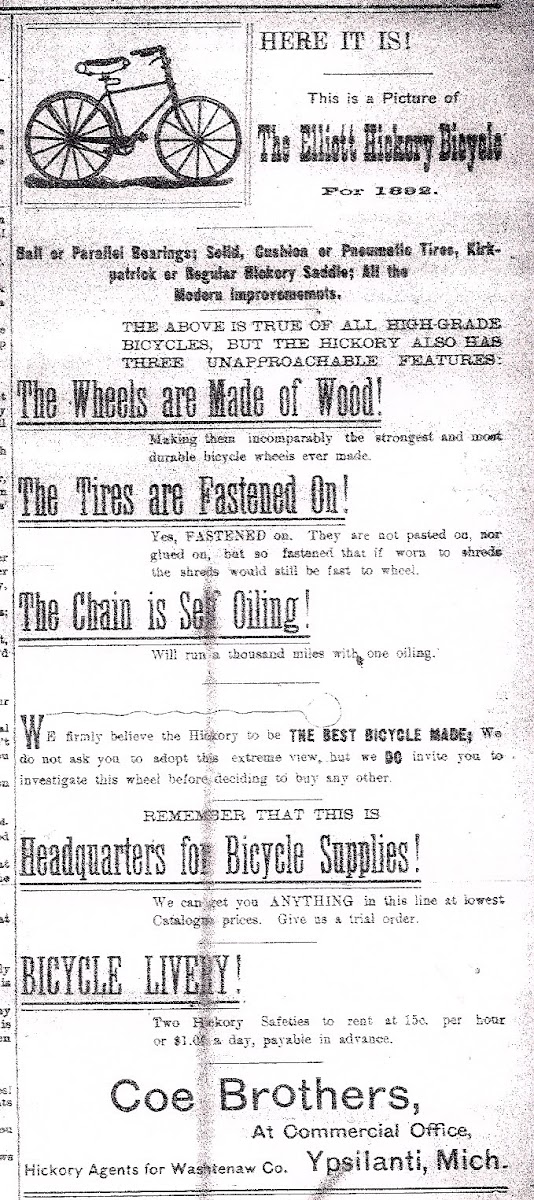
Not only did the paper rent bikes, they also sold them. At least, they sold the Elliott Hickory Bicycle, a model sporting two wooden wheels with tires that were "fastened" on. "Yes, FASTENED on," says the ad below. "They are not pasted on nor glued on, but so fastened that if worn to shreds the shreds would still be fast to wheel." Dusty D is not sure why riding on shreds is being advertised as a feature, as opposed to a nice soft tire, but I'm not a bigtime newspaper editor-slash-bicycle purveyor, and as such--clearly wiser minds than mine have made this ad.
The paper at this time was headed by Henry Coe, assisted by his brother Fred. Henry's twin career of newspaper editor and bicycle seller and livery manager seems to have been a short one. The Commercial continued for another eight years, but mentions of the bike livery vanish in short order from the paper. Perhaps it wasn't much of a loss; the livery had consisted of a fleet of only two bikes. The onetime cobblestones on many downtown streets might have made short order of those four wooden wheels (mounted to frames without shock absorbers), whether festooned with tenacious shreds or no.
Yet another brief flash of the onetime plethora of oddball business ventures in our town.

Thursday, February 17, 2011
Tidbits from the February 17, 1888 Ypsi Commercial
Kicked off with a jab at those who came to Ypsilanti to visit the Occidental spa on North Huron Street and "take the waters":

A thirteen-year-old boy who stole something gets hauled off to reform school, apparently for YEARS:

Folks from olden times are hearkening back to even earlier times with a reenactor party. 15 cents in 1888 is equivalent to $3.50 today.

The death of Robert Campbell, father-in-law to Ypsi poet-farmer William Lambie, dies at William's home in Superior Township just outside the city limits:

Finally, Michigan Avenue druggist Frank Smith combines personal and professional advertising in his bid for a housegirl and his roster of wares, many of which were the patent medicines of the day:


A thirteen-year-old boy who stole something gets hauled off to reform school, apparently for YEARS:

Folks from olden times are hearkening back to even earlier times with a reenactor party. 15 cents in 1888 is equivalent to $3.50 today.

The death of Robert Campbell, father-in-law to Ypsi poet-farmer William Lambie, dies at William's home in Superior Township just outside the city limits:

Finally, Michigan Avenue druggist Frank Smith combines personal and professional advertising in his bid for a housegirl and his roster of wares, many of which were the patent medicines of the day:

Sunday, February 13, 2011
Notes from the Ypsi Newspaper Wars
In the time-honored rivalry of Ypsilanti newspapers, the Feb. 15, 1889 Commercial takes a swipe at the Ypsilantian for being slow to the news:

"Enterprise? After T. C. Owen had been manufacturing Toilet Soap from his Mineral Water for over a year, and the Commercial job department had printed over a hundred thousand wrappers for him, the Ypsilantian suddenly, and without giving its readers the least warning, one day announced that Mr. Owen had begun to manufacture soap.
"The September ’88 number of the Normal News, and each of the six succeeding issues, announced in the advertising columns that Mr. Owen had chanced the name of his Mineral water and products to “Atlantis,” instead of “Ypsilanti.” Yesterday, our contemporary tried to palm that fact off on an unsuspecting public as fresh news.
"It is expected that late next fall, or at least early in the winter, the Ypsilantian will state that Mr. Owen has been dealing in ice for the past summer.
"Such enterprise on the part of our brother news-gatherer, is remarkable!"

"Enterprise? After T. C. Owen had been manufacturing Toilet Soap from his Mineral Water for over a year, and the Commercial job department had printed over a hundred thousand wrappers for him, the Ypsilantian suddenly, and without giving its readers the least warning, one day announced that Mr. Owen had begun to manufacture soap.
"The September ’88 number of the Normal News, and each of the six succeeding issues, announced in the advertising columns that Mr. Owen had chanced the name of his Mineral water and products to “Atlantis,” instead of “Ypsilanti.” Yesterday, our contemporary tried to palm that fact off on an unsuspecting public as fresh news.
"It is expected that late next fall, or at least early in the winter, the Ypsilantian will state that Mr. Owen has been dealing in ice for the past summer.
"Such enterprise on the part of our brother news-gatherer, is remarkable!"
Wednesday, February 9, 2011
A Homeopathic Dose of Money
Sensible folks know that homeopathy is nonsense. Yet it's all too easy to assume that in the quaint old past, people gave credence to this buncombe. After all, even the U of M had a department of homeopathy. Surely people thought this was a valid treatment back in the day, when they didn't know what we know today.
It's easy to assume so. Yet that would be wrong. Even in its day, homeopathy was ridiculed by many contemporaneous folks. I've read a joke in a late 19th-century Ypsi paper about a baby drinking up a bottle of medicine and a mom panicking. "Don't worry, Ma--it was only a homeopathic medicine. He won't be affected in the least."
Here's another tidbit of evidence that homeopathy was viewed with skepticism by many. It's an ad from the 1892 Ypsi city directory. The newspaper, from its office at the southeast corner of Cross Street and Huron, is advertising its job printing services for anyone who needs a church bulletin or commencement booklet or the like.
"FOR MONEY (A HOMEOPATHIC DOSE) WE WILL DO YOUR PRINTING."

It's easy to assume so. Yet that would be wrong. Even in its day, homeopathy was ridiculed by many contemporaneous folks. I've read a joke in a late 19th-century Ypsi paper about a baby drinking up a bottle of medicine and a mom panicking. "Don't worry, Ma--it was only a homeopathic medicine. He won't be affected in the least."
Here's another tidbit of evidence that homeopathy was viewed with skepticism by many. It's an ad from the 1892 Ypsi city directory. The newspaper, from its office at the southeast corner of Cross Street and Huron, is advertising its job printing services for anyone who needs a church bulletin or commencement booklet or the like.
"FOR MONEY (A HOMEOPATHIC DOSE) WE WILL DO YOUR PRINTING."

Wednesday, February 2, 2011
Cartoons from the 1888 Ypsilanti Commercial
For a while in the summer of 1888, the Commercial ran a series of small syndicated cartoons in its front-page "Local" section. What strikes Dusty D, though this may be a banal observation, is that people dressed so formally for everyday business. I doubt the concept of casual clothes even existed except for the so-called "wash frock." It's also interesting to note that whereas men's clothing is nearly identical to today's men's formal clothing, women's clothing has changed far more radically--imagine being corseted all day and schlepping around yards and yards of fabric...not sorry I missed that. Anyways, let's take a peek.
 (From an era many decades before car seats and urban assault strollers).
 Here is a caricature of a German immigrant, and the cartoonist found it acceptable in that day and age to print the conversation in dialect. The dialogue: I. "Officer: Look out there man! Don't you see that runaway coming?" II. "Spagmeyer (as everything comes up standing) Dey's geddingbooty gareless mit deir horses in this town, ain'd id?"
 Now, I frankly don't get this one. You can see that the pictures hanging on the wall in the background mirror the names of the couple. Is it funny because "Butch" was regarded as a coarse or low-class moniker? Was "Butch" a slang term for a pig? (Tried to find that out, no luck). I just don't know.
 Oh, the horrors! Note the cushion on the floor for Mama's feet. The Ypsilanti Historical Museum has a Victorian-era footwarmer. It's a fabric-covered box in which one can place coals. Just another reminder that homes were COLD! Uninsulated, poorly and unevenly heated...central heating, except for the very wealthy, wouldn't become common until well after the turn of the century.
 And a humorous jab at an airheaded lady who just can't restrain herself from peeking at the big ending without bothering to read the entire book. Note her complicated dress complete with bustle--phew, what an ensemble to have to tote around each day. And so ends our peek at some bits of humor from the past.
 (From an era many decades before car seats and urban assault strollers).
 Here is a caricature of a German immigrant, and the cartoonist found it acceptable in that day and age to print the conversation in dialect. The dialogue: I. "Officer: Look out there man! Don't you see that runaway coming?" II. "Spagmeyer (as everything comes up standing) Dey's geddingbooty gareless mit deir horses in this town, ain'd id?"
 Now, I frankly don't get this one. You can see that the pictures hanging on the wall in the background mirror the names of the couple. Is it funny because "Butch" was regarded as a coarse or low-class moniker? Was "Butch" a slang term for a pig? (Tried to find that out, no luck). I just don't know.
 Oh, the horrors! Note the cushion on the floor for Mama's feet. The Ypsilanti Historical Museum has a Victorian-era footwarmer. It's a fabric-covered box in which one can place coals. Just another reminder that homes were COLD! Uninsulated, poorly and unevenly heated...central heating, except for the very wealthy, wouldn't become common until well after the turn of the century.
 And a humorous jab at an airheaded lady who just can't restrain herself from peeking at the big ending without bothering to read the entire book. Note her complicated dress complete with bustle--phew, what an ensemble to have to tote around each day. And so ends our peek at some bits of humor from the past.
Thursday, January 27, 2011
Tidbits From the 1888 Commercial: A Visit to the Commercial Printing House
Dusty D's favorite paper from Ypsilanti's past is definitely the Ypsilanti Commercial. Originally edited by the tempestuous C. R. Pattison, the paper was taken over in 1887 by the Coe Brothers when Pattison retired.
 The Commercial under Pattison was pro-Temperance, pro-suffrage, and anti-slavery. Pattison engaged in regular and fiery criticisms of the other city paper over at Michigan Avenue and Washington, the Sentinel.
Under Pattison, the Commercial printing house stood on top of the Riverside Park sledding hill on the southeast corner of Cross and Huron; it later moved to Pearl and Huron. But it wasn't just a newspaper. They did all sort of job printing for anyone who wanted posters, commencement booklets, wedding announcements, church bulletins, calling cards, and so on. Dusty D's Baltimore grandfather, Charles Benjamin Franklin Bien, was a job printer, and DD's dad, a longtime printing press mechanic, owns a beautiful old-school self-inking platen press.
A look at some tidbits from the January 27, 1888 issue gives a peek at life in the printing house.
Here's one example of the job printing done there: a color poster advertising the Cornwell Fire Company's Masquerade Ball. Dusty D is not sure why a fire company is throwing a gala masquerade, but there you are.
 Another item published at the Commercial was the Normal News, the campus newspaper.
 Under the Coe Brothers (later just Henry Coe), the Commercial gentled down a bit from Pattison's fusillades of the past. They even went so far as to reprint a most charming description, taken from their rival the Sentinel, describing an evening of sleighing and reading.
 A final charming tidbit details a handwritten newspaper written by two young Ypsi boys, even finding space in the Commercial to reprint one of their jokes.

 The Commercial under Pattison was pro-Temperance, pro-suffrage, and anti-slavery. Pattison engaged in regular and fiery criticisms of the other city paper over at Michigan Avenue and Washington, the Sentinel.
Under Pattison, the Commercial printing house stood on top of the Riverside Park sledding hill on the southeast corner of Cross and Huron; it later moved to Pearl and Huron. But it wasn't just a newspaper. They did all sort of job printing for anyone who wanted posters, commencement booklets, wedding announcements, church bulletins, calling cards, and so on. Dusty D's Baltimore grandfather, Charles Benjamin Franklin Bien, was a job printer, and DD's dad, a longtime printing press mechanic, owns a beautiful old-school self-inking platen press.
A look at some tidbits from the January 27, 1888 issue gives a peek at life in the printing house.
Here's one example of the job printing done there: a color poster advertising the Cornwell Fire Company's Masquerade Ball. Dusty D is not sure why a fire company is throwing a gala masquerade, but there you are.
 Another item published at the Commercial was the Normal News, the campus newspaper.
 Under the Coe Brothers (later just Henry Coe), the Commercial gentled down a bit from Pattison's fusillades of the past. They even went so far as to reprint a most charming description, taken from their rival the Sentinel, describing an evening of sleighing and reading.
 A final charming tidbit details a handwritten newspaper written by two young Ypsi boys, even finding space in the Commercial to reprint one of their jokes.
Thursday, January 20, 2011
Tidbits from the January 20, 1888 Ypsilanti Commercial
What were Ypsilantians up to according to the January 20, 1888 issue of the Ypsilanti Commercial? Well, the Women's Christian Temperance Union met at Mrs. Buchanan's house, a shipment of ice came in on the train, and it was a bit too slippery to safely walk around.

Without screens, radio, or even (for most folks) telephones, what on earth did people do to enjoy themselves and socialize during the winter? Sleigh rides are peppered all throughout the January issues of the weekly Commercial. For the less adventurous, euchre and pedro card games were popular.

And 1888 was a leap year. In reading the old Commercial, there are several references in the January issues to the fact that this apparently presents some sort of romantic opportunity to "the ladies." I get the impression that leap years were regarded as a sort of Sadie Hawkins year. Dusty D had never heard of this before--perhaps its a forgotten custom. Here the Commercial reprints some leap-year advice from the Ann Arbor Courier.


Without screens, radio, or even (for most folks) telephones, what on earth did people do to enjoy themselves and socialize during the winter? Sleigh rides are peppered all throughout the January issues of the weekly Commercial. For the less adventurous, euchre and pedro card games were popular.

And 1888 was a leap year. In reading the old Commercial, there are several references in the January issues to the fact that this apparently presents some sort of romantic opportunity to "the ladies." I get the impression that leap years were regarded as a sort of Sadie Hawkins year. Dusty D had never heard of this before--perhaps its a forgotten custom. Here the Commercial reprints some leap-year advice from the Ann Arbor Courier.

Tuesday, November 23, 2010
Thanksgiving Note to the Ministers of Ypsi from Editor C. R. Pattison
 C. R. Pattison was the most fiery editor in all of Ypsilanti history. He treated his paper, the Ypsilanti Commercial, as a large cannon. He didn't fire it in every weekly issue of the Commercial, but when he did not even local ministers were out of range.
 The Commercial's printing-house stood at the corner of Huron and Cross Streets, though I don't know which corner it stood on. In the November 22, 1884 edition, Pattison tells local preachers to tone it down already.
As a rule Thanksgiving sermons are unmercifully long. This fact has kept a great many people away from church. A year's thoughts and ideas are piled into one effort. Boil down, cut off the prefaces and expletives and long drawn conclusions. Give the solid meat.
Again enough singing is piled service to last five years. Last year we laid up the program of song, such a multiplicity of pieces on purpose as a reminder to this coming occasion, but we have mislaid it.
At all events short prayers, not over three glorious Thanksgiving hymns, a brief boiled down wide awake sermon, and there will be many more thankful souls. Many a good woman can give the promised good dinner and yet enjoy the church service, many a farmer and farmer's wife can come to church and get back to their turkey, and not grumble all the way homeward and be [ticked off...]
In the very same issue, even on the same (front) page, Pattison delivered another editorial, this one aimed at the Commercial's detractors.
Some would like to have the Commercial tamed or toned down so as to give no progressive ideas, to be very careful not to advance a step beyond the path it has been accustomed to tread. Not give its readers anything to think of but lull them to sleep with the same old song. Better give them something to get mad on, for they will soon get over it and feel better, than to administer to a perpetual stagnation of thought and action. It is the glory of American freemen that they are not hampered and if they kick and get a little mad [they] yet have common sense enough to soon get over it and behave manfully and nobly. The COMMERCIAL would not be worth taking did it not stir up your laggard brains and ideas occasionally. Count on it doing so at least when you need it bad.
Tuesday, December 15, 2009
"Stomp" in 1878
 SOME NORMAL STUDENTS DROP INTO MUSIC
--On Saturday morning last, as the City Marshal was taking his walks abroad, he was startled by loud noises proceeding from that part of the city known as "Normaldom."
Repairing thither he found a band of twenty or more youths engaged, so they said, in serenading. The music not being music when it reached the ears of the Marshal, he requested them to stop, a thing which they promptly did. Before they had gone far, however, the fences were again made to act as drums, and semi-musical notes again rent the air.
Following up this chorus, the Marshal again made a request for quiet, remarking, by way of an aside, that he would be sorry to add to the list of boarders at the City Hall Hotel. Whereupon, one young gentleman remarked that during a long life he had never put up at any but first class hotels, and that he did not mean to begin now. The noise, however, was stopped, and soon that part of the city was locked in sleep.
The Marshal, thinking that the disturbance, if let alone, would be but the prelude to others of a graver character, and, after being requested so to do by the inhabitants of the Normal quarter, entered a complaint against two of the leaders of the chorus, and, on Monday morning called for them at the Principal's office. After a few characteristic words in support of the law, the Principal turned his students over to justice.
At first the choristers pleaded not guilty, but finally changed their plan and were, by the advice of the City Attorney, let off with costs amounting to about $8.00. This sum the chorus made up, and the boys declared that the singing was cheap enough for them.
--Ypsilanti Commercial, December 14, 1878


