
Wednesday, July 27, 2011
Mystery of the Missing Blood Vials
Two tiny vials containing what was said to be the first blood spilled in the Civil War once occupied a spot in the onetime science museum in what is now EMU's Sherzer Hall. The pic below is a never-before-published shot of what is thought to be part of the museum. It only came to light when one Archives member recently scanned a large number of old glass-plate negatives. Thanks to the Courier for publishing my story about the vials!


Monday, July 25, 2011
Mrs. Emoretta Garlick caused the arrest of Daniel O'Brien for assault and battery, and the examination took place Wednesday morning before Justice Childs. The plaintiff failed to furnish security for the payment of costs, and Prosecuting Attorney Randall refused to proceed.
It has been rumored for some time that Lee Harrison, who is dying of consumption, would make some startling revelations in regard to the Pulver murder before he died. In order to put these at rest he has made a sworn statement before Attorney Brown that he knows nothing whatever about the case.
--July 25, 1895 Ypsilantian
It has been rumored for some time that Lee Harrison, who is dying of consumption, would make some startling revelations in regard to the Pulver murder before he died. In order to put these at rest he has made a sworn statement before Attorney Brown that he knows nothing whatever about the case.
--July 25, 1895 Ypsilantian
Friday, July 22, 2011
Breining Farm in Augusta Township, Whittaker Road, c. 1895
German immigrant Martin Breining was an Augusta Township farmer. In 1880, he was 43. His English immigrant wife Mary was 39 and had had the first eight of her 13 children: Lizzie, Austin, William, Melvin, Charles, John, Mary, and Verny. By 1900, at age 59, she had also given birth to Clarence, Mertie, Fread, Walter and the youngest, 6-year-old Wesley.

The Breiner farm was just south of Ypsilanti off Whittaker Road.

An aerial view from Google Maps shows that the Breining land outlines are still visible over a century later. Here is it visible as a lush green square just south of Bemis.

A photo from around 1900 shows the family members:

Some closeups:


This person is a bit of a mystery. I don't see any non-relative farm hands listed on the old censuses, but this man's old overalls and work boots suggest that that was his role on the farm.

At least two of Martin's sons left the farm and moved into Ypsilanti for urban jobs. William worked as a baggageman and Charles as a clerk. Martin died in 1906 and his wife Mary a year later. He is buried in Stony Creek Cemetery. Several of his children are buried there, and later others were buried in Highland Park Cemetery.
The Breiner farm was just south of Ypsilanti off Whittaker Road.

An aerial view from Google Maps shows that the Breining land outlines are still visible over a century later. Here is it visible as a lush green square just south of Bemis.

A photo from around 1900 shows the family members:
Some closeups:


This person is a bit of a mystery. I don't see any non-relative farm hands listed on the old censuses, but this man's old overalls and work boots suggest that that was his role on the farm.

At least two of Martin's sons left the farm and moved into Ypsilanti for urban jobs. William worked as a baggageman and Charles as a clerk. Martin died in 1906 and his wife Mary a year later. He is buried in Stony Creek Cemetery. Several of his children are buried there, and later others were buried in Highland Park Cemetery.
Ann Arbor, July 22--John Heerst, a farmer residing about three miles north of Ann Arbor, has filed suit by his solicitor, Geo. J. Burke, to the circuit court here asking $1,000 damages from the Ann Arbor railroad, for a horse which he alleges was run over and killed by a train on that road. The notice of suit does not state whether Heerst is a breeder of horses or not, but up to the present time it was not supposed that there was a horse of that value in Washtenaw county. --July 22, 1909 Ypsilanti Daily Press
Thursday, July 21, 2011
Aerial Views of King's Flats, Early 1930s
These are a collection of aerial views of what was once called "King's Flats" just southeast of downtown, where the Huron once wound through a flat floodplain. The 1874, 1895, and 1915 plat maps shows one Edward King owning land on both sides of the river in the area that is now Ford Lake. Here are Edward King's landholdings on the 1874 map:

The legend on the envelope that houses the photos in the Archives reads, ""These pictures were taken by Dr. H. Britton and his wife while flying their plane over what was known as King's Flats. It was to have a record to show how this area was before King's Flats was flooded to become Ford Lake."
Each photo is also labeled. This one's legend reads, "Looking east. South river road [Huron River Drive] running up center. Beginning work on Ford Dam at left center. Rear edge of lower wing at lower left. Tip of tail at upper right."

"Looking northwest, King's Flats at lower left. Struts and wires of plane at right."

"Looking east. Beginning of Ford Dam at upper right center."

"Looking east. King's Flats. South river road runs up center of picture."

"Looking east. King's Flats in lower right corner."


The legend on the envelope that houses the photos in the Archives reads, ""These pictures were taken by Dr. H. Britton and his wife while flying their plane over what was known as King's Flats. It was to have a record to show how this area was before King's Flats was flooded to become Ford Lake."
Each photo is also labeled. This one's legend reads, "Looking east. South river road [Huron River Drive] running up center. Beginning work on Ford Dam at left center. Rear edge of lower wing at lower left. Tip of tail at upper right."

"Looking northwest, King's Flats at lower left. Struts and wires of plane at right."

"Looking east. Beginning of Ford Dam at upper right center."

"Looking east. King's Flats. South river road runs up center of picture."

"Looking east. King's Flats in lower right corner."

Tuesday, July 19, 2011
From One-Room Schoolhouse to Lincoln Consolidated Schools
This photo labeled "1924" shows the presumably new Lincoln Consolidated School District and the previous one-room schoolhouses from which it drew its pupils, the sons and daughters of Ypsilanti Township farmers. In an era of increasing industrialization, car ownership, and the dawn of the Jazz age, the time of one-room schoolhouses in Washtenaw County was fading.

Monday, July 18, 2011
On Saturday and Monday street fakers visited this city and caught more than the average number of fish. The Indian doctor? on Monday evening capturing a hat full of silver dollars.
Who says the bike is not more powerful than the legislature to compel a reduction in fares? Tuesday morning last week Mr. and Mrs. Lee Forsyth of this city mounted their wheels and started for Kankakee, Ill., reaching Battle Creek the first day. They expected to make their visit and return yesterday. But for the bike they would probably have paid $35 to the railroad company, but this they saved. The time may come when the railroads will acknowledge the competition of the bike, and cut their fares or lose their custom.
Miss Maggie Smith, a young girl of 16, tried to commit suicide last Tuesday by taking a dose of laudanum. She was ashamed of her mother who is addicted to the use of strong drink. Her rash act was discovered in time to save her life.
--July 18, 1895 Ypsilantian
Who says the bike is not more powerful than the legislature to compel a reduction in fares? Tuesday morning last week Mr. and Mrs. Lee Forsyth of this city mounted their wheels and started for Kankakee, Ill., reaching Battle Creek the first day. They expected to make their visit and return yesterday. But for the bike they would probably have paid $35 to the railroad company, but this they saved. The time may come when the railroads will acknowledge the competition of the bike, and cut their fares or lose their custom.
Miss Maggie Smith, a young girl of 16, tried to commit suicide last Tuesday by taking a dose of laudanum. She was ashamed of her mother who is addicted to the use of strong drink. Her rash act was discovered in time to save her life.
--July 18, 1895 Ypsilantian
Sunday, July 17, 2011
1 in 47
 Almost 100 years ago, the ratio of Washtenaw residents to cars was 47 to one.
"These figures come from the secretary of state, who has just completed a compilation, showing the number of automobile tags issued up to June 16, 1913, and the counties into which they have been sent. Up to the first of the month [they] had issued 47,138 automobile licenses, 13,199 more than were issued in the same period during 1912 . . .
"Ingham county leads the state with one car to every 11 of its inhabitants. Branch county has one for every [42?], Washtenaw one for every 47, Wayne one for every 48, and Kent, with the state's second city, drops far below these with one car for every [60?] residents . . ."
At this time Washtenaw county had 942 cars total.
--July 17, 1913 Daily Ypsilantian-Press
Saturday, July 16, 2011


The Old Huckleberry Line
The old Huckleberry Line ran from Ypsi down to "Bankers," Michigan, 64 miles away. It's gone now...but not forgotten. Here is an affectionate portrait of the onetime railroad. Thanks, Chronicle! Below: 1875 map showing the Huckleberry.


Friday, July 15, 2011
When Kids Demanded Milk
I could be reading too much into this little cartoon from the January 22, 1951 Ypsilanti Daily Press but--oh, for the days when kids demanded milk.
I like the mini fridge and didn't realize fridges that small were made at one time. I also note that he freezer is sensibly on the bottom. Wonder why they switched it to the top. In addition, Mom is shopping in heels...urgh. Can't say I'm sorry I was born after that era.
203 Prospect is just north of Michigan Ave. and south of the crumbling railroad bridge. So in 1951 Ypsilanti had a hometown dairy, "owned and operated by Ypsilantians." It's also news to me that as late as 1951, 3-digit phone numbers apparently still existed.
"More milk, please, Mom!" Ah, if only...

I like the mini fridge and didn't realize fridges that small were made at one time. I also note that he freezer is sensibly on the bottom. Wonder why they switched it to the top. In addition, Mom is shopping in heels...urgh. Can't say I'm sorry I was born after that era.
203 Prospect is just north of Michigan Ave. and south of the crumbling railroad bridge. So in 1951 Ypsilanti had a hometown dairy, "owned and operated by Ypsilantians." It's also news to me that as late as 1951, 3-digit phone numbers apparently still existed.
"More milk, please, Mom!" Ah, if only...

Classified Ad WTSH (What the Sam Hill)
 Okey-dokey. Here's a July 15, 1909 Ypsilanti Daily Press ad placed by someone who seeks to come personally to your house and collect your hair combings.
 The nice long ones. Presumably you've saved them, right? Not cuttings--combings. This person pays cash! Cash on the barrelhead, ladies, for those combings of yours. After which this person will call on several other folks for their combings and then traipse right on home with a handful of different people's combings...
...to do WHAT?!
Tuesday, July 12, 2011
A Forgotten Ypsilanti Product
 This is a photocopy of a bottle of a onetime Ypsi product: horseradish.
 "D. Ballinger" probably refers to the man listed in the 1910 directory as David Ballinger, Ypsi gardener married to one Eva and living at 614 Congress. If so, David apparently grew, ground, and bottled his own horseradish!
Sadly "Ballinger's Horseradish" never became a household phrase.
Brought to Dusty D's attention by the bottle's owner, E.
Monday, July 11, 2011
Mystery Doodad
Here's a strange little device from an ad in the June 15, 1939 Ypsilanti Daily Press. Can you divine what it might be?

The item, as friend J. K. correctly guessed, is a vacuum brew coffee maker. He also sent a link to a modern-day version (only $209!) The one in the link uses a spirit lamp, neato. Here's a video of how one works. The vacuum brewer above uses electricity. It is one of the myriad electric doodads that the Detroit Edison Company trotted out early in local municipal electrification days, which began roughly three decades before this 1939 ad. They just wanted to make your life more convenient!
The ad below is for a public cooking class with a new electric roaster at the Masonic Temple (Riverside Arts Center) led by "well known home economist" Lillian Merson. The glass coffeemaker was one of the three door prizes for this event, the others being one of the roasters and a "toaster tray set."
Roaster cooking is true electric cooking--cool, clean, fast, healthful, convenient--and it costs only about 2 cents an hour!


The item, as friend J. K. correctly guessed, is a vacuum brew coffee maker. He also sent a link to a modern-day version (only $209!) The one in the link uses a spirit lamp, neato. Here's a video of how one works. The vacuum brewer above uses electricity. It is one of the myriad electric doodads that the Detroit Edison Company trotted out early in local municipal electrification days, which began roughly three decades before this 1939 ad. They just wanted to make your life more convenient!
The ad below is for a public cooking class with a new electric roaster at the Masonic Temple (Riverside Arts Center) led by "well known home economist" Lillian Merson. The glass coffeemaker was one of the three door prizes for this event, the others being one of the roasters and a "toaster tray set."
Roaster cooking is true electric cooking--cool, clean, fast, healthful, convenient--and it costs only about 2 cents an hour!

The Ann Arbor Courier is kicking against the Michigan Central because the grounds at the depot in Ann Arbor are not kept in better condition. Of course they do look a little bare to one who has seen those at Ypsilanti, but then, they can't expect the Central to furnish a Laidlaw for every flag station along the line. --July 11, 1895 Ypsilantian
Wednesday, June 29, 2011

Wednesday, June 22, 2011

Saturday, June 18, 2011
Pokagon Tipi at EMU
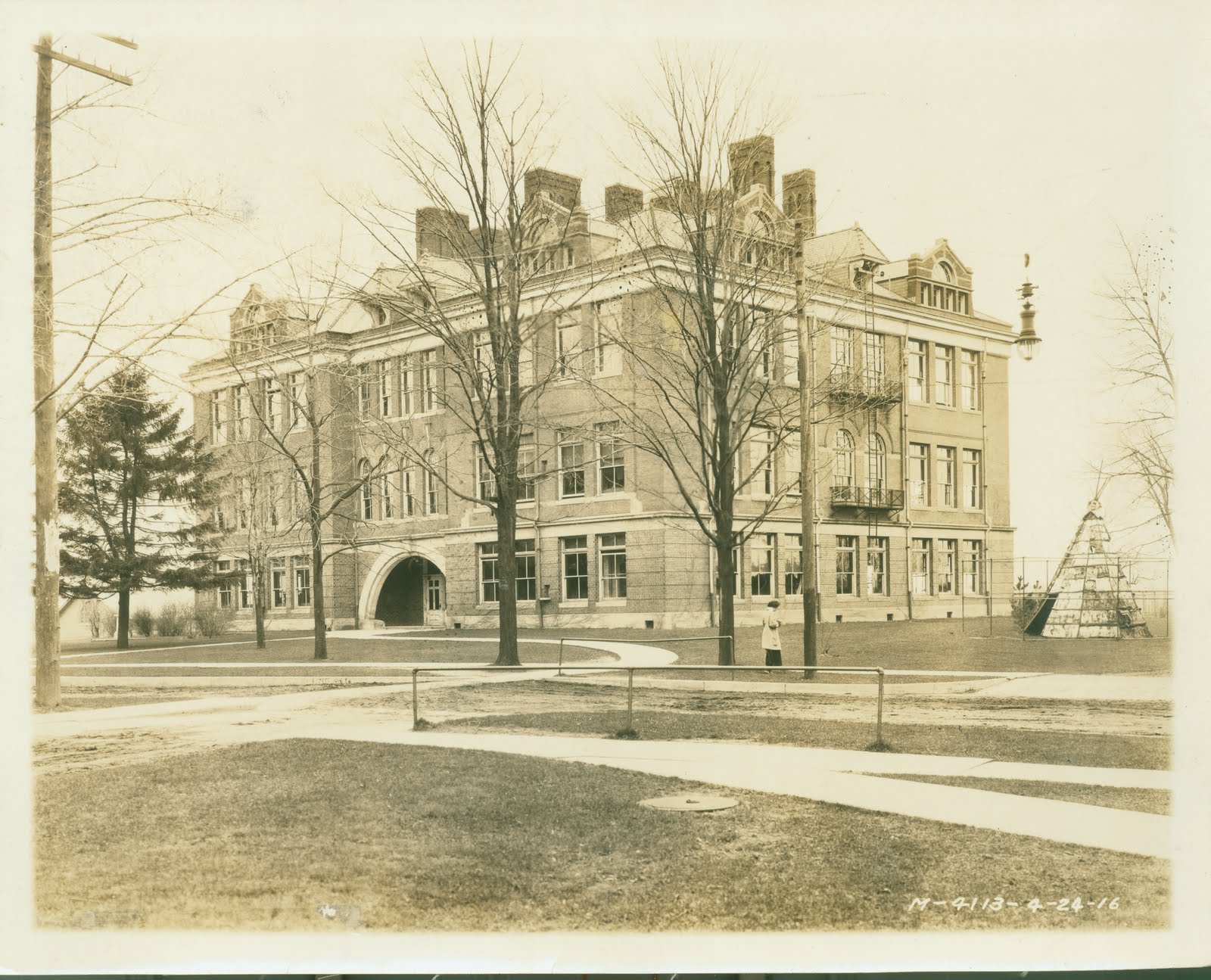
Today during volunteer time at the Archives I found this much better 1916 photo of the onetime Pokagon tipi at EMU. Wow. This is very similar to the photo that, cropped, appears in my copy of the 1918 EMU "Aurora" yearbook (and in the post below). I'm definitely putting this photo into my book "Hidden Ypsilanti." One chapter of "Hidden" deals with the splintery edges of immigrant assimilation or cultural clashes between peoples, and this definitely speaks to that theme. At any rate, you can see that the tipi once stood on the eastern edge of the modern-day Sherzer Hall, which was nearly lost to a fire in the late 80s. To its credit, EMU rebuilt this venerable old 1903 (?) lady instead of wrecking it. Second oldest building on today's campus I believe. Props to EMU!

Friday, June 17, 2011
Sherzer Hall (in 1918, the Science Building) with Pokagon Tipi
This photo from the 1918 "Aurora" yearbook from EMU has a hidden gem. Though it focuses on the Science Building, now called Sherzer Hall, take a look at the extreme right. That strange little structure is the onetime birchbark tipi that used to stand on campus. It was built by Simon Pokagon, and the story of its creation offers a thread back to the days of Potawatomi. The Potawatomi were onetime residents of Washtenaw County at one point in their migratory history, and later and today, continue to live in southwest Michigan (and areas in adjoining states as well as reservations out West).

Today of course the tipi is long gone. It stood on the east side of Sherzer.

Another view of the east side of Sherzer where the tipi once stood in its cage. You can see the north-south double walkway leading to the street to Halle.
 Below is an early 20th-century picture postcard of the tipi. The story of this tipi and of its history and cultural background appears in my upcoming book Hidden Ypsilanti, which will be out this fall. I'm working hard on this book right now--it has summer deadlines, which is why blog posts have been a bit thin on the ground lately. Please bear with me as I try to make Hidden as good as I can, and stay tuned. Thanks for reading!


Today of course the tipi is long gone. It stood on the east side of Sherzer.

Another view of the east side of Sherzer where the tipi once stood in its cage. You can see the north-south double walkway leading to the street to Halle.
 Below is an early 20th-century picture postcard of the tipi. The story of this tipi and of its history and cultural background appears in my upcoming book Hidden Ypsilanti, which will be out this fall. I'm working hard on this book right now--it has summer deadlines, which is why blog posts have been a bit thin on the ground lately. Please bear with me as I try to make Hidden as good as I can, and stay tuned. Thanks for reading!
Wednesday, June 15, 2011
Postcards from the Archive
The front entrance to the onetime main building of the State Normal School.


Friday, June 10, 2011

Thursday, June 9, 2011

Wednesday, June 8, 2011
A Sad Accident.
Mr. Walters in the employ of Cornwell & Co., at the paper mill, was caught in the shafting of the straw cutter last week, and the terrible result was the loss of his arm, which had to be amputated at the shoulder. He is just over from England, having been only two days in the service of the Messrs. Cornwell. --Item in the June 7, 1878 Ypsilanti Commercial
Mr. Walters in the employ of Cornwell & Co., at the paper mill, was caught in the shafting of the straw cutter last week, and the terrible result was the loss of his arm, which had to be amputated at the shoulder. He is just over from England, having been only two days in the service of the Messrs. Cornwell. --Item in the June 7, 1878 Ypsilanti Commercial
Local Support for an Unpopular Cause in 1874
 When 19th-century women's rights activist Elizabeth Cady Stanton gave a pro-suffrage speaking tour in Michigan in 1874, the year the state voted on the issue, reactions ranged from warm support to derision. The divided reactions are seen in miniature by reactions within our own town in June of 1874. Ypsilanti's Sentinel newspaper, headed by Charles Woodruff, published anti-suffrage editorials against the movement, some quite scathing. At the Commercial, editor C. R. Pattison spoke out strongly in favor of suffrage, as in the editorial below. In it he criticizes the Detroit Post for its stance against Ms. Stanton [paragraph breaks added for readability].
"The Detroit Post is in tantrums about Mrs. Stanton’s canvass of the State.
"It copies every miserable, slimy slander in regard to her speeches. Mrs. Stanton’s speech in this city was entirely unexceptionable. It was very far from denunciatory; it was mild, persuasive, eloquent, argumentative, and convincing. The bitterest opponents of women suffrage were compelled to admit that her address was eminently adapted to win votes. We believe that this is the case wherever she speaks.
"The fact is, the Post and kindred sheets fear the powerful blows she is striking against the remains of feudalism and prescription of sex. Not possessing the manliness to come out and oppose it in an open above board manner, the Post and a few papers of its class seek to prejudice voters by side issues, and especially exciting prejudice against the ablest canvassers. This attempt will prove an utter failure.
"Wherever Mrs. Stanton speaks the hearers will be watching for the evidence of the slanderous cricicisms heaped upon her, and will be agreeably surprised to find that they are most unjust aspersions, and thus they will the more easily be persuaded to take the right side. So keep on your villianous, insidious, covert slanders. The rebound will make the cause a host of votes.
"Common sensed men will reason that a cause that can only be met by innuendo and misrepresentations must be based on the rock and worthy of their confidence."
Stanton image used under fair use provisos, from http://www.spartacus.schoolnet.co.uk/USAWstanton.htm.

Tuesday, June 7, 2011
Tour of the Interurban Car Barn on Michigan Ave.
 Man, it sure is easy getting around on the interurban. The Detroit, Jackson, and Chicago lines go all over Southeastern Michigan, as seen in this Wikipedia map. Want to go shopping in Detroit? Just hop on at the downtown Ypsilanti waiting room and enjoy the ride. But how does this all work from a local standpoint?
 The noisy, smoky nexus of the local interurban node stood just east of the Huron River, on the north side of Michigan Avenue. Though the main waiting area and boarding spot was downtown, this car barn was the site of cars coming and going for repairs, as workmen tended the enormous switchboard and rank of giant whirring dynamos.
The smoke belching from the plant was an issue in the southern River Street neighborhood, with residents complaining of laundry dirtied by falling soot; eventually the factory installed what were then called chimney "smoke suppressors," easing the problem somewhat. Many of the workmen at the plant, husbands of the wives battling with dirty laundry, lived in the same River Street neighborhood.
And we're in luck; look along River Street there--some workers are just walking back to work after lunch at home. How about this guy with the coal dust all over his pants? Let's ask nicely--does he mind if we tag along and take a quick look inside the plant? Yeah, he guesses that's OK, if we don't hang around. All right, we're in! Let's follow him and check it out.
Here's what we see as we approach the building, as viewed from Michigan Ave.

Our guide says that the bays on the left are the "car barns" proper. There's room for six cars. The central door leads to the main business office. On the right is a large bay leading to a big repair shop for the cars, which also houses a carpenter shop and a blacksmith shop. This is mass transit with a local DIY twist. Since our guide is headed there, let's tag along.

Our guide says he has to get back to work but that we can take a quick look around. Here's the repair shop. In the back right you can see the body of an interurban car. In the foreground lie stacks of...hmm, are these some kind of axle-transmission components? They also resemble motors. Don't want to bother one of the guys in back, but he could tell you...to most of us, the names of this part are lost. Now let's check out the nerve center of the plant: the nearby switchboard area.

What did the switchboard control? I would guess the flow of electricity to various lines, to start and stop different cars without the expense of keeping all of the lines electrified at all times. Before we can ask, the worker there asks us to leave. OK, OK, but we're not done checking out the plant.
Exiting the main building with its switchboard, office, and repair shop, let's go outside, and circle around to the back of the building. Here, on the northeast side housed in a separate structure, was the heart of the plant: the dynamo house. Jeez, what a racket! Wow, look at that!

This is arguably the most dangerous place in all the plant, here by the rank of whirling dynamos. None of them have safety shielding. Considering the mass of the flywheels and their velocity...not a place to come to work a bit hung over on Monday morning. In fact, it's a bit scary here and I think we've seen enough. Let's skedaddle.
We've bothered the guys enough; they have work to do. As we leave, let's take one look back from the perspective of Materials Unlimited to wave and say thanks, guys, for this insider's look at our onetime local mass transit system.

Monday, June 6, 2011
The Newspaper's Wooden-Wheeled Bicycles
Want to take a spin around town in 1892 Ypsilanti, but can't afford to buy a new bike? No worries: just pop down to the Ypsilanti Commercial offices at 316 North Huron (between Emmet and Cross) and rent one for a mere 15 cents per hour (about $3.60 today).
Not only did the paper rent bikes, they also sold them. At least, they sold the Elliott Hickory Bicycle, a model sporting two wooden wheels with tires that were "fastened" on. "Yes, FASTENED on," says the ad below. "They are not pasted on nor glued on, but so fastened that if worn to shreds the shreds would still be fast to wheel." Dusty D is not sure why riding on shreds is being advertised as a feature, as opposed to a nice soft tire, but I'm not a bigtime newspaper editor-slash-bicycle purveyor, and as such--clearly wiser minds than mine have made this ad.
The paper at this time was headed by Henry Coe, assisted by his brother Fred. Henry's twin career of newspaper editor and bicycle seller and livery manager seems to have been a short one. The Commercial continued for another eight years, but mentions of the bike livery vanish in short order from the paper. Perhaps it wasn't much of a loss; the livery had consisted of a fleet of only two bikes. The onetime cobblestones on many downtown streets might have made short order of those four wooden wheels (mounted to frames without shock absorbers), whether festooned with tenacious shreds or no.
Yet another brief flash of the onetime plethora of oddball business ventures in our town.
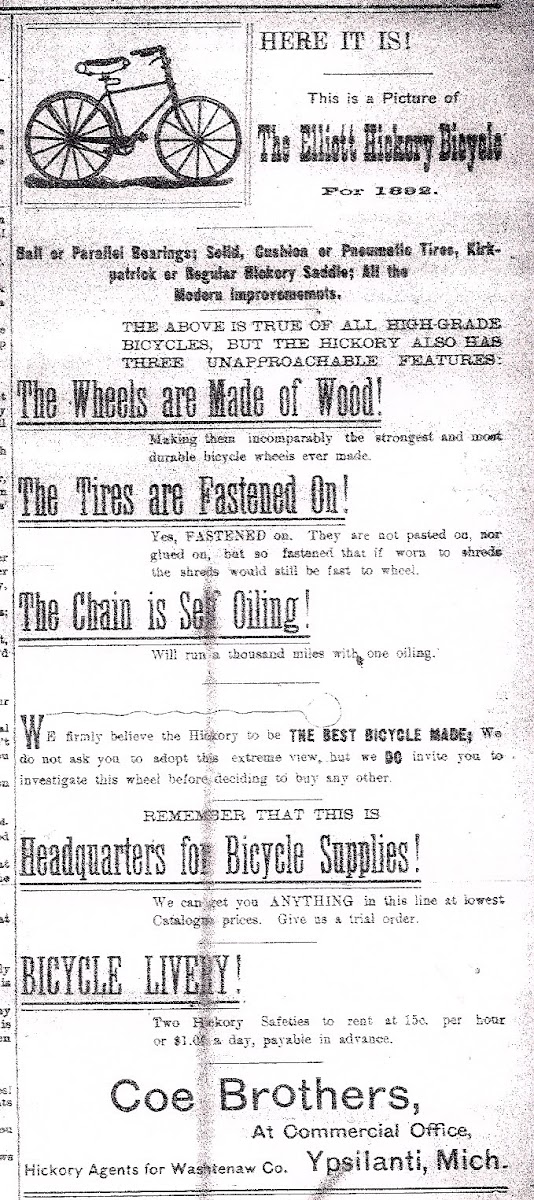
Not only did the paper rent bikes, they also sold them. At least, they sold the Elliott Hickory Bicycle, a model sporting two wooden wheels with tires that were "fastened" on. "Yes, FASTENED on," says the ad below. "They are not pasted on nor glued on, but so fastened that if worn to shreds the shreds would still be fast to wheel." Dusty D is not sure why riding on shreds is being advertised as a feature, as opposed to a nice soft tire, but I'm not a bigtime newspaper editor-slash-bicycle purveyor, and as such--clearly wiser minds than mine have made this ad.
The paper at this time was headed by Henry Coe, assisted by his brother Fred. Henry's twin career of newspaper editor and bicycle seller and livery manager seems to have been a short one. The Commercial continued for another eight years, but mentions of the bike livery vanish in short order from the paper. Perhaps it wasn't much of a loss; the livery had consisted of a fleet of only two bikes. The onetime cobblestones on many downtown streets might have made short order of those four wooden wheels (mounted to frames without shock absorbers), whether festooned with tenacious shreds or no.
Yet another brief flash of the onetime plethora of oddball business ventures in our town.

Sunday, June 5, 2011
Shockingly Immoral Boys
 Student pastor Fred Merrifield had some news for the good Temperance ladies in June of 1909. According to him, the moral condition of Ann Arbor boys was in a shocking state. However, he had a plan to straighten them out with the help of some upright U-M students.
"Rev. Fred Merrifield, student pastor of the Baptist church, dropped a bomb in the middle of a W. X. T. U. meeting when he told the good ladies that boys in Ann Arbor between the ages of 13 and 16 were existing under shockingly immoral conditions; that gangs of these lads habitually associate with women of the lowest possible depravity; that the low class of Ann Arbor saloons encourage these young lads congregating at the rear doors of their places and furnish them with the filthiest literature.
"Mr. Merrifield pointed out that these boys could not be reached by the usual methods of the Y. M. C. A. because they were too poor to pay the fees that such organizations demand, and he asked for money to be donated for the rent of rooms, promising that he would have the help, without financial compensation, of 20 university students--'good, clean university men, not on the sissy order'--to take upon themselves the duties of giving these lads instructions in gymnasium work and in placing before them educational advantages that they could never hope for otherwise."
--June 5, 1909 Ypsilanti Daily Press
Thursday, June 2, 2011

Wednesday, June 1, 2011
Postcards from the Archive
This postcard was saved with the name "is this ypsilanti.jpg." Hmm........is it?


X-Ray Finds No Heart in Miss Roosevelt
St. Louis--Miss Alice Roosevelt posed before the big X-ray machine at the German section of the educational building at the World's Fair to-day. The result was edifying to the beholders, but startling, too, for, try as he would, Prof. Leopold Bahlsen, who was operating the machine, could not locate Miss Roosevelt's heart.
Miss Warder, her Washington friend, and Miss Catlin, her hostess, stood revealed before the rays as possessors of hearts of generous proportions and so did the man of the party. Not so Miss Roosevelt. Repeated efforts revealed nothing more than the first experiment showed, and the other members of the party agreed that Miss Roosevelt must have lost her heart. --June 1, 1904 Ypsilanti Evening Press
Miss Warder, her Washington friend, and Miss Catlin, her hostess, stood revealed before the rays as possessors of hearts of generous proportions and so did the man of the party. Not so Miss Roosevelt. Repeated efforts revealed nothing more than the first experiment showed, and the other members of the party agreed that Miss Roosevelt must have lost her heart. --June 1, 1904 Ypsilanti Evening Press





